FAQs
Last updated: 28 March 2013.
Questions added in last update are flagged *NEW*
This page lists below all the questions and answers raised in relation to Round 2 of the Employer Ownership Pilot. They have been grouped under the following headings:
In addition we have published the answers to the questions raised by employers during the recent webinar series. In total nearly a hundred questions were posed covering all aspects of the Pilot.
There is also an interactive guide available to download – ‘What you need to know’. This provides answers to the most frequently asked questions and aims to bust some popular misconceptions along the way.
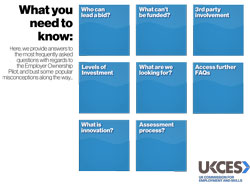 (PDF, 125 Kb)
And you can still view the FAQs from round 1
We have published substantial advance and guidance, the following list of all questions and answers raised via the enquiry channels and from the webinars. However, we appreciate you may still need to get in touch with someone with a specify query as we approach the application deadline.
Please select the right contact email for your query:
What is the deadline for submitting my application?
The deadline for round 2 applications is 13.00hrs on Thursday 28 March.
We encourage you to submit your bid at anytime during this final week in good time before the deadline, after which your application will not be considered.
How do I submit my application?
Your application needs to be submitted via the web-portal Bravo – which you can only access if you successfully registered and expressed your interest for the EOP2 project.
When filling in your application please remember to answer all of the mandatory questions.
In addition, please quote the Unique Reference Number (URN) that was sent to you after you ‘expressed an interest’, on all of your application documents, where requested.
What happens if I experience technical difficulties during my application submission?
If at any time during the application process you experience technical difficulties or require technical assistance, you should contact the portal helpdesk at [email protected]. You must supply a "screen dump" or "screen shot" depicting any error messages you have received. You must tell us before the 13.00 deadline if you have experienced any technical difficulties in submitting your application, otherwise your application will not be considered.
The application from Bravo is supplied in Word 2003. When I submit my final application form, can I do so in a different version of Word?
For avoidance of doubt and any potential problems we request that you ensure completion of the Questionnaires in Word 2003. In any event you should note the following: [email protected] is not aware that completing in a more current version will cause submission and evaluation problems, but as Bravo only uses Word 2003 they are unable to confirm whether this is indeed the case.
Bravo will only assess the characters you provide in each answer up to the maximum locked in to each answer as indicated in each question in the Word 2003 version attached to the process. We suggest therefore that prior to submission you may wish to carry out a character/word count.
How will I know if I have successfully submitted my application prior to the deadline of 13.00 28 March?
Upon submitting your application, you will receive 2 prompts alerting you to your successful submission. The first will be a pop up screen immediately upon clicking ‘submit’ within Bravo – this will say that ‘you have successfully submitted your response to the buyer’. The second will be an email from Bravo solutions stating ‘This email is to confirm that you have successfully published your response’.
*NEW*Just noticed some inconsistencies with EOP form template. Guidance notes suggest font Arial, size 11pts. When cutting and pasting into protected template provided this is Arial, size 12pts. Secondly, number of characters inconsistent. I have drafted responses in a separate document and when doing character count these are within number limitations. However, when pasting into template, it cuts off characters at the end. Thirdly, template does not allow tables to be inserted. Advice/guidance welcome on these issues and whether or not others are experiencing the same problems.
The font should be at Arial size 12. They must adhere to the number of characters allowed in the template. If this is the case, then they will need to find a format other than a table.
*NEW*On the outline part 2 (spreadsheet) it would like a breakdown of ages of future apprentices. At this time I don’t know what the ages will be exactly as we will be employing new people. I have a total figure over the lifetime of the project – can I split them between the age groups and then say estimate?? We are still in discussions with some partners about how much cash they can give and then the in kind bits will all depend on a number of other factors. Can I again just estimate these costs knowing we will have this finalised if we were to get through the next stage??.
It is understandable that they do not know the precise ages and costs of the apprentices at this stage, so they should provide an estimate – and highlight that this is an estimate in the bid.
*NEW*Where an employer programme provides multiple employability experiences to young people as opposed to accredited training, how do you reflect this within the learner numbers spreadsheet?
Input the number of individuals who will be undertaking learning at different qualification levels i.e. Levels 1, 2, 3 and 4+. Any learning at the same level should be grouped together for the purposes of this table – even if the nature of the learning is different.
Back to top
How can I bid?
Applicants should complete the on-line application form detailing the proposal including financial information.
Where can I get a copy of the application form?
The application forms for full and outline bids are available as pdfs on the UK Commission website. Here you will also be able to find a link to the online e-tendering portal, which includes all documents to be completed. Follow the prompts to make sure all information is supplied.
What help is available to complete the application form?
A series of advice surgeries will be held in February and March. To register please see visit the advice surgeries page on this website
The Guidance for Applicants (PDF, 438 Kb) document offers applicants advice on filling in the application forms. In addition, you can find instructions on how to navigate Bravo, the e-tendering portal, in the application and guidance section of this website.
Who should I contact for queries with the application form or process?
Queries can be submitted through the online message board on the e-tendering portal, or the BIS mailbox at [email protected]
Do I need to express my interest?
Yes. You need to express your interest in submitting a bid to the pilot by 13.00 11 March 2013.
What is the deadline for bidding?
The deadline for applications is 13.00 on Thursday 28 March 2013.
There is an opportunity to apply either with a full or an outline bid on the 28 March. Who do you envisage applying with a full bid, and who do you expect will use the outline stage?
We expect the outline stage to be used by complex or collaborative bids that need the time to develop their proposals. We encourage other applicants to submit a full bid on which a funding decision can be made more quickly, with activity to start from October 2013.
How will the development phase work?
Successful bidders will receive feedback from the Investment Board and will then have 12 weeks to work the proposal into a full bid.
How does the sifting and assessment process operate?
An independent Investment Board will oversee the sifting and appraisal process. There will be an automatic sift to ensure applications forms are completed properly. Please make sure you fill in all the required parts of the application form. There will also be an eligibility check, where we will check that your bid is led and submitted by an employer. Depending on the number of applicants, bids will then be sifted on the basis of a sub-set of criteria. Bids remaining will then be assessed on the full application.
The Investment Board will review shortlisted applications and select those that fit most closely with the assessment criteria. Final decisions will be taken in the context of ensuring a balanced portfolio of investments.
Has the final Investment board been approved? Would it be possible to know who will be on this or what sectors they belong to?
The Investment Board has not yet been approved, but it will be chaired by Charlie Mayfield (UKCES Chairman), involve 3 or 4 UKCES Commissioners, plus representatives from BIS, SFA and DFE.
How will bids be assessed?
Bids will be assessed against the evaluation criteria set out in the Prospectus, which will measure how well bids meet the pilot objectives.
For economic benefit and value for money assessments, only economic benefits which are deemed to be additional to what would happen without Government support will be considered. The full investment criteria are available as part of the application form and guidance pack.
How will you assess value for money?
When assessing the value for money of the project we consider a range of aspects including the expected quality and quantity of learning outcomes per £ of Government investment , how much employer investment the project includes, whether the skills development and training would have been possible without Government funding and any wider social benefits that the project could be expected to generate.
What do you mean by innovation? Why is this so important?
The Employer Ownership Pilot is about changing the skills landscape for employers. We want a more responsive system for the future that helps employers to source what they need when they need it. To do this we need employers to come forward – tell us what skills you need in your workforce and what is the most effective way of getting them; we want ideas that challenge the norm, suggestions that can really work for you.
In a nutshell a proposal is considered to be innovative if it proposes a new collaboration or funding model, or a piece of training or method of delivery that is not currently available.
Current training methods may be constrained by provider timescales or you may need a mix of elements that are not currently being delivered together. It could even be that the training you need is for something new and so nobody has developed anything that suits. Whatever the reason for you not being able to find training that currently meets your needs, you are being innovative if your bid makes a proposal for a solution that is fit for purpose.
In the application form, as well as explaining the proposed innovation, you will also be asked how you propose to manage the innovation to maximise the chance of successful delivery.
What will the audit requirements be if projects are successful?
Audit requirements will be as light-touch as possible while meeting the requirements for managing the distribution of public funds. They will be proportionate for the project and its size and risk. We will establish with successful bidders the right audit arrangements for their project.
How will you measure the quality of the training being delivered? Will it be required to be delivered to industry / sector approved standards?
The training proposed does not need to conform to industry/sector approved standards, but applicants will need to set out in their bid how they will ensure the quality of the training proposed. This includes stating how quality standards will be set and met. More information is available in the Guidance for Applicants document.
If we are successful what happens next?
Once informed of a successful bid, and following necessary due diligence, we will agree a grant letter with the bidder which will set out the terms of the agreement and the structures for accountability.
How and when will we receive our funding?
Payment schedules will be agreed as part of the grant negotiation process but payments are generally made in arrears against agreed outcomes.
If we are unsuccessful, will there be another chance to bid?
There is currently no commitment to a third round of the pilot.
If a full bid is unsuccessful we cannot treat it as an outline bid for further development.
If we are unsuccessful, can we appeal?
There will be no opportunity to appeal the final decisions.
If we are unsuccessful, can we get feedback on our bid?
Feedback will be available to the lead employer of an unsuccessful bid after the final decisions are announced. To request feedback the lead employer should email [email protected]
Back to top
Who can bid?
The pilot is open to employers of all sizes and sectors. Whilst employers can be based anywhere, the benefits must focus solely on England. We encourage bids from groups of employers working together in their sector, supply chain or local area, but single employers can also apply, provided bids are above the bid threshold levels.
We are particularly keen that SMEs participate, either as part of a supply chain proposal, or in a collective bid developed in conjunction with other partners, for example a Local Enterprise Partnership, a National Skills Academy, a Sector Skills Council or through a Group Training Association. However, the lead organisation(s) should be the employer.
Must the bid be led and submitted by an employer, or can an intermediary lead and submit the bid?
The bid must be led by an employer(s) and must be submitted by the lead employer(s) on the e-tendering portal.
Whilst an intermediary can play a key role acting to bring partners together and to co-ordinate activity, the proposal must be employer led: it must respond to the skills needs that employers have identified, and the employers must also be involved in developing the proposed solution. This is in line with the core principle of the pilot: employer ownership of the skills agenda.
What about infrastructure projects or infrastructure elements within a bid? Should these be lead by an employer or the intermediary?
The bid still needs to be led by the employer. However, you will need to identify an eligible intermediary to manage the funding for any funding proposed for underpinning arrangements (the skills infrastructure elements of the bid).
Who can act as a grant recipient for the infrastructure component of the funding?
The guidance states that projects bidding to develop skills infrastructure must nominate a not-for-profit body to be the grant recipient for the related funds. Having a not-for-profit intermediary to manage this funding may help in achieving state aid compliance for the project. However, if you do not have a not-for-profit intermediary involved in your bid, you can nominate a different intermediary to act as the grant recipient for the infrastructure component, if you can assure yourselves that this will not compromise your state aids position.
Must an employer still lead a bid for EOP Round 2 where bids go beyond training cost elements?
Yes, there must still be an employer lead for EOP Round 2 bids. This is to demonstrate that proposals are genuinely driven by and respond to employers’ needs and will form part of the application form. Applications which seek investment in underpinning arrangements to ensure skills needs are better met in a sector, locality or supply chain will need to have a suitable employer representative body to lead that element and be accountable for its funding.
In applications which only involve investment in training costs we do not need an intermediary body to be identified; however, we do expect that an intermediary, such as a LEP, will be useful in some circumstances to bring bidders together, acting as the conduit to manage activity and funding.
What is the position on third parties (GTAs, LEPs, business representative bodies, SSCs, Trade Associations, Colleges/providers, Work based learning organisations etc) leading bids?
They cannot lead the bid. All bids must be led by a named employer(s). Bids will require the signature of the CEO or an alternative Director from the lead employer(s) who will understand and support the proposal.
Can a third party be nominated to manage the project? If so, would the grant offer letter and due diligence be completed with the third party?
If a bid is successful and the lead employer(s) have nominated a third party to manage the project on their behalf (including the funding), then due diligence and grant offer letter negotiations will be undertaken with that third party. The application form asks for a statement covering the need for a third party and how the employer(s) will remain engaged in the project. In Round 1, Grant Offer Letters typically include details of governance arrangements including how employer(s) views will continue to lead the direction and delivery of the project. In terms of financial accountability, the grant recipient is responsible for the funding.
What is the role of the “lead employer(s)” in the bid process?
The lead employer(s) is the employer(s) that are fronting the bid, identifying the skills gap and driving the proposed solution. It is the lead employer(s) who must register and submit the bid on the e-tendering portal.
We fully recognise that being the one company named in a bid could be off-putting, especially for SMEs. We are therefore allowing for more than one “lead” employer in a collaborative bid; employers can share the ownership and commitment as well as the benefits of the project.
To signal that there is more than one lead employer, please write all the lead employers in the organisation name field when registering on the e-tendering portal. (For the other fields, please just enter the first company’s details, for our reference.)
In addition, applicants should set out all the organisations who are participating in the project in table 5b in Part 1 of the application form, as shown below. You can use this table to state all the lead employers.
| Name of organisation |
Type of organisation |
Organisation size |
Role in project |
Estimated proportion of total staff currently undertaking training in each employer (%) |
Can a sector representative trade organisation (which is a private sector led limited company with a private sector board), or a Registered Charity (also with private sector board members) be a lead employer for bid purposes?
A sector representative body cannot be the lead employer. However, a group of senior managers of companies could come together and put themselves forward as leads with the endorsement of their companies – this fits with our view that limiting the lead to one company can be off-putting for SMEs. The fact that this group may be a sub-set of a formal representative body is secondary and would not cause problems with the bid.
Can companies based outside England submit bids?
Whilst your organisation can be based anywhere, the benefits of your proposal must focus solely on England.
What constitutes an Industrial Partnership? How many bidders from the sector/region would you expect to see in an industrial partnership?
Whether you consider your bid to constitute an industrial partnership is as much about the approach to the skills need(s) of your sector/region, the scale of your proposal and the wider sectoral/regional support for the proposal as it is about the number of organisations signed up. You do not need to have all the organisations from your sector/region signed up to be an industrial partnership. However we would expect industrial partnerships to be significant and long term partnerships to take end to end responsibility for skills development in a sector/place. Therefore, we would expect to see wide sectoral/regional support for the proposal, and the involvement of a variety of partners, including SMEs. The partnership would demonstrate how planned activities and investments align with wider sectoral/regional plans for growth, for example in areas such as technological innovation, finance etc. as well as to the strategic skills priorities.
Further information on industrial partnerships is set out on page 7 of the Prospectus.
If I submit a bid for an "industrial partnership" but BIS/UKCES do not consider it to be one, will my bid still be appraised?
As the above FAQ states, an "industrial partnership" is not easily defined and we will still assess your bid however it is labelled. Since all bids are assessed on the same criteria this will not affect your bid. For MI purposes we will re-classify this as a non industrial partnership bid.
If I’m submitting an Industrial Partnership bid, how much support from the sector/region does the proposal need?
You will be asked to provide evidence of the extent of the support for the bid in the application form. You could demonstrate broad support by, for example, direct involvement in the bid of a representative range of players in the sector/region (including employers of different types and sizes, and cross-sectoral/regional bodies) and reference to strategic analysis, both pre-existing or specially commissioned, which has broad sectoral/regional support.
Will the involvement of a Local Enterprise Partnership (LEP) strengthen a bid?
An LEP can play a key role in bringing partners together and co-ordinating activities, but other organisations can also act as an intermediary, such as Sector Skills Councils (SSCs). It is for individual bids to decide whether they would benefit from the involvement of a 3rd party.
Are you open to voluntary organisations/public sector bids?
All employers are eligible. We do ask bidders to note that the pilot aims to develop skills to support economic growth. Any bid from the public and voluntary sector will need to demonstrate how it contributes to growth.
How does EOP fit in with the Industrial Strategy? And will you be favouring bids from Industrial Strategy sectors? Is it worth those from other sectors applying?
It is essential that we have the right skills in the sectors of UK business with the greatest potential to deliver growth. Without the trained specialists, technicians and engineers, we will not meet the goals of the industrial strategy. The key to establishing a partnership with the priority sectors will be the production of sector strategies. As we have seen with the Aerospace strategy, these will need to address sector-specific skills issues to deliver international competitiveness. The Employer Ownership Pilot is aimed broadly but we have already seen innovative proposals from priority sectors and we are keen to see more in Round 2.
However, we are also interested in bids from sectors not mentioned. We are interested to see bids which bring together employers and partners in regions or cities. However, the key criteria of employer ownership, quality and rigour, innovation, feasibility, value for money and future prospects remain the grounding factors in assessing bids, and final decisions will be made in the context of ensuring a balanced portfolio of investments.
Can employers be involved in more than one bid?
Whilst applicants are not limited in the number of bids they can make, they are encouraged to focus on submitting thorough and high quality bids. Where an employer will be involved in more than one bid, it is important we understand how separate bids involving the same entity are considered mutually exclusive.
Can companies submit multiple bids via its subsidiary companies, which are legal entities in their own right, or do they need to submit a single bid from the parent company covering all the proposed projects?
We have not placed any restrictions on how employers structure their proposal regarding parent and subsidiary companies. In choosing which party is best placed to bid and how the bid is structured, applicants may wish to consider how bids would be best presented to the Investment Board. Applicants should also ensure that their proposal is compliant with the relevant State Aid conditions of the General Block Exemption.
What are the differences between Round 1 and Round 2?
We are building on the lessons learnt from Round 1 and are pleased to be able to commit more funding to co-invest with business for Round 2, and to invite even more ambitious bids that embrace the challenge posed. In this round:
- The funding will be available over three years rather than two.
- We have aligned the Growth and Innovation Fund (GIF) with EOP, simplifying the application process for bidders and allowing us to provide funding for skills infrastructure as well as for training places.
- While the pilot continues to be broadly based, we are keen to see bids which address issues highlighted in Vince Cable’s Industrial Strategy thinking, set out in his speech of 11 September 2012.
There are six assessment criteria for Round 2, four of which are the same as Round 1: quality and rigour, innovative approaches to skills and workforce development, impact and value for money, and feasibility. The two additional criteria are a greater focus on employer ownership, which reflects the central theme of the pilot, and future prospects, in which we are looking at the long term potential of the proposals. More details on these criteria can be found in the prospectus on our website
We were turned down for funding in round 1. Can we reapply?
Yes. We encourage previous bidders to build on the feedback provided from the round one assessment in developing any potential bids for round 2.
How can SMEs take part?
We encourage SMEs to apply and value the contribution they can make. We have deliberately introduced a lower threshold for SME bids of £250,000.
We appreciate that significant resources are needed to engage with a competitive bidding exercise, and our experiences from round 1 were that SMEs involved in collaborative bids were often more successful in articulating and addressing the specific challenges they faced. Therefore we encourage SMEs to consider:
- working locally with their Local Enterprise Partnerships (LEPs) or Chamber of Commerce, or with their Sector Skills Council or National Skills Academy, to find out whether there are other organisations with whom they could collaborate. Indeed these organisations themselves may play a role to bring SMEs together, acting as a catalyst for high quality employer-driven bids
- whether they are well placed to bring together other SMEs, perhaps because they are market leaders in innovation or cutting edge technology;
- working with a local college or training provider to consider how the flexibilities of this pilot might better meet their needs than the mainstream skills offer. Again, the college or provider may themselves bring SMEs together.
We and our partners are engaging in engaging in an extensive awareness raising campaign around Round 2 of the pilot. This includes events where employers can ask questions and we encourage SMEs to come along. We will also be signposting SMEs to local support, including Local Enterprise Partnerships, Chambers of Commerce, Sector Skills Councils and colleges, who are well placed to help SMEs develop bids. We are also looking to national bodies including the Federation of Small Businesses to use their contacts to work with and support SMEs.
We already have a contract for apprenticeships delivery with the Skills Funding Agency or National Apprenticeships Service. Can we still submit a bid?
Yes. Bids should set out how the proposal relates to any existing public funding arrangements. You can discuss the relationship between your existing contract and the pilot with your Skills Funding Agency or National Apprenticeships Service account manager.
Do training providers need to be registered on ACTOR (the Skills Funding Agency’s Register of Training Organisations)?
For the pilot there is no requirement for training providers to be on ACTOR.
It is up to employers to decide which training provider best meets their needs and bids should set out clearly how they will do this and how employers will satisfy themselves on the quality of provision.
Does any training specified have to be accredited QCF and on LARA database?
No. Training only needs to be relevant to the employer.
If the consortium of employers has a particular provider in mind, that can deliver what they want, do they have to incorporate them as a partner? Or can they bypass the procurement process?
Yes, we will need to understand who the delivery partner is, so please include in the application process.
With regards to the Employers choosing a provider, how much of the red tape or usual standards can be bypassed?
Ultimately it is for the employer to satisfy themselves that the provider delivers value for money and quality. We will consider how you have identified the provider as part of your procurement process, and in the application form, applicants will be asked to set out their delivery partners and provide the detail of their contribution to the project/ area of expertise.
Can I include proposals for non-standard apprenticeships within my bid?
Yes. The Specification of Apprenticeships Standards for England (SASE) sets out the minimum requirements to be included in a recognised English apprenticeship. In many cases we would expect bids to include SASE-compliant apprenticeship frameworks. However bidders are encouraged to think creatively about new apprenticeship models. This could include developing new recruitment strategies or other apprenticeship solutions where they do not currently exist. Where this is the case, proposals should explain the rationale for the approach; how the quality of training will be enhanced; and how the breadth and depth of learning apprentices need will be provided.
Through whatever approach is proposed, successful apprentices will be expected to have:
- acquired significant new knowledge and technical qualification(s), recognised to be important to the sector
- become competent in their current role
- been supported towards achieving English and maths to the level of a GCSE A*-C where they do not already possess this
- good progression opportunities once they have completed, either in work or into further/higher education.
Apprentices will also have gained significant new skills, and not simply been accredited for those they already have.
If a bid includes public investment for a new apprenticeship framework in an area where a SASE-compliant framework exists, the proposal must explain how this new framework goes beyond and improves on what is already available.
What are Traineeships and how do they relate to the Employer Ownership of Skills Pilot Round 2?
The Government has announced that it is developing a new Traineeships programme, which it intends to become the preferred route into work for young people who aspire to Apprenticeships or other jobs but who need additional training to reach their goals. BIS and DfE published a Discussion Paper on Traineeships on 10 January 2013.
It proposes a core model of a work placement, work preparation training and English and maths for those who need it. Any additional elements can be decided locally to suit the needs of young people and employers but could include, for example, vocational units or one-to-one mentoring. We encourage applicants to consider the opportunity to apply for EOP funding to test versions of Traineeships that are tailored for their local labour market and young people
Must our funding proposals fit within how the Government currently funds training, e.g the Government’s incoming policy on 24+ Loans?
The Employer Ownership pilots are testing out innovative approaches to designing and delivering training, including how it is funded. The nature of the pilot means that some training can be funded through EOP which wouldn’t be available through mainstream funding arrangements. Whilst the funding levels involved in EOP do not have to relate to mainstream funding rates or policy, and there is no set percentage contribution expected against specific activities, please note that value for money and impact are key investment criteria against which all bids are assessed. Funding levels will also have to be agreed by the project’s account managers as part of the negotiation process for successful EOP applicants.
What should a bid include?
We have highlighted a number of points applicants should consider when putting together a bid.
- The outcomes they wish to achieve
- The rationale behind the proposal
- Why it can’t be done through existing funding routes/delivery channels
- The mechanism by which it will be delivered
- The level of private investment
- The public investment needed to make it happen
Back to top
How much money is available?
There is £340 million available for the pilot, with around £250m to be co-invested for round 2, over the years 2013-14 to 2015-16. Where round 2 bids include training or apprenticeships that start within that time but will not be completed by March 2016, we will fund the completion of that activity where appropriate.
Why has the Growth and Innovation Fund (GIF) aligned with EOP? What does it mean for those who would have bid for GIF funding? And does this mean there is extra money to invest?
To simplify the co-investment opportunities available to employers and present a unified bidding process. It also helps bidders to help tackle skills challenges holistically: by aligning the funds, we are making government investment for training places as well as skills infrastructure available through the same source. We expect that industrial partnerships will put forward proposals that integrate training places and infrastructure elements.
However, there may be some proposals, including a small number already in the Growth and Innovation Fund process, which do not include a training cost component. These can be submitted to EOP Round 2 and will be assessed under the published criteria for this round of Employer Ownership.
We have aligned the EOP and GIF principally because feedback from Round 1 told us that bidders wanted the flexibility to include skills infrastructure alongside training places in their proposals. The total investment pot stands at £340 million.
How does the stated £340m of funding for EOP tie in with the figures published in the Skills Funding Statement (which adds up to c. £127m)?
The Skills Funding Statement sets out the indicative EOP budget, broken down by financial year until 2014-15. This only represents the funding available for individuals aged 19 or above, and excludes the funding supplied by the Department for Education, which funds training pre-19. In addition the Skills Funding Statement only lists funding up to FY 2014-15, while EOP now offers funding through to FY 2015-16.
Can you provide clarity on the £250k and £1m funding thresholds?
We want to see significant and scalable proposals for skills investment and therefore the minimum cash investment from Government will be £250,000 for collaborative proposals involving SMEs, and £1 million for individual or consortia bids involving large employers (defined as employing 250 employees or above).
Will my bid have to comply with State Aids rules?
Yes. Applicants should assure themselves that their application is state aid compliant. Where applicants are unsure about their responsibilities in relation to state aid, it is important they seek independent legal advice before submitting an application. We consider that the De Minimis Regulation and the General Block Exemption Regulation provisions on training will generally provide legal cover. More information is available in the guidance, including links to introductory advice on State Aid.
What is the difference between public funding and publically granted aid?
Publically granted aid is any money that originated from a public body, and is made available to an organisation as permissible State Aid. When made available the body providing the money will have advised whether this was the case. Typically this will be through a notified scheme using the General Block Exemption or as De-Minimis aid.
Public funding is money made available to an organisation that is passed on commercial terms through a procured contract or as a grant that is not considered State Aid.
Can my project combine public money from different sources?
Potentially yes. For example it may be possible to combine money granted through this pilot with money granted by other Government funding schemes to achieve a better result overall. For example money granted by the Regional Growth Fund to fund infrastructure and Employer Ownership Pilot money to fund training.
If an employer wants to do this they will need to make sure that the money that has been granted, or from which their organisation might benefit, is compliant with State Aid regulation. In general, you can combine funding if it is for different types of eligible costs. If an employer wants to combine money in this way they should explain this clearly in the application, including an explanation of how the different funding streams are complementary and not double-funding the same activity.
Do you have a specific contribution from employers in mind in terms of percentage?
There is no defined level of investment we require from employers, but we would expect good bids to have clear and substantial financial commitments from employers. Levels of employer investment will be taken into account in the investment criteria used to assess bids.
What is considered valid as employer contribution?
Employer contribution can either be in cash or in-kind. Examples of in-kind contributions include the use of a room or equipment hire, staff/management time, free advice. You will be asked to substantiate all in-kind costs/contributions in the application form. Contributions in time for one-off completion of questionnaires/interviews by employers or attendance at short one off meetings is not considered meaningful in terms of direct financial cost to the project itself and therefore should be excluded from in-kind contribution calculations and totals. Further information can be found in the Guidance document.
The pilot is designed to test the concept of greater employer ownership of skills and part of this is about leveraging in greater employer investment and looking to fund activities that wouldn’t have happened in the absence of the proposed pilot project. Employers therefore need to demonstrate that any employer contribution they propose is specific to the project. Other sources of public funding are not considered valid as employer contribution to the project.
Will EOP fund investment in tangible fixed assets e.g. property and equipment?
The Employer Ownership Pilot will not fund investment in tangible fixed assets. Employers are welcome to use their own contribution to their proposal to fund the purchase or development of tangible fixed assets.
Can the funding be used to train self employed apprentices or to teach a young person to be self employed?
Any potential applicant considering a bid of this nature would need to consider how their proposal would meet the investment criteria for the pilot as outlined in the prospectus and application guidance.
Can the pilot fund learners from the age of 16 plus?
Yes. For learners aged 16-18 yrs old there is particular emphasis on ensuring a substantial and meaningful learning experience, including recognising the greater support likely to be required by those entering the workforce for the first time.
Apprenticeships should be a core element of workforce development opportunities offered, and for this age group public funding will focus in this area. Innovative approaches to Apprenticeships content and delivery are very welcome for younger people, as they are for adults.
Can the funding be used for higher education or higher apprenticeships?
Funding from the Employer Ownership Pilot is not available to fund higher education courses but can support Higher Level Apprenticeships.
Does employer investment have to be cash? Can it be in kind?
Bids can include both in-kind and cash investment, but we are keen to see proposals that show significant commitments in a number of ways.
How will co-funding work?
Co-funding proposals for joint bids will be specific to each bid. Bidders should explain in their application what arrangements they propose and we will work with successful bidders to determine an appropriate arrangement.
When and how are payments made?
If successful, and after due diligence, a grant letter will be agreed with the bidder, or nominated grant recipient. Payment schedules will be agreed as part of this grant negotiation process but payments are generally made in arrears against agreed outcomes.
What happens beyond round two?
This is a pilot scheme and what happens beyond the pilot depends on the outcome of the evaluation and the Government’s Spending Review.
Will there be a Round 3?
There is no current commitment to a round 3. Lessons we learn from round 1 and round 2 about the impact of direct employer influence on will be used to inform the Government’s skills strategy.
*NEW*Is it possible for employer acting as lead to receive all EOP funds then distribute GIF elements accordingly? This would save lead employer having to establish multiple commercial agreements as not all the infrastructure developments may be undertaken by a not-for-profit organisation. For example, framework developed by not-for-profit intermediary, learning platform and data feeds developed by technology partner who is commercial. Having the technology elements paid via intermediary is unnecessary and another level of bureaucracy.
It is for employers to determine the best structure for their projects and the appropriate recipients for grant funding of each element. In doing so they should consider any potential State Aid implications, taking appropriate professional advice where required.
Back to top
