
Our workRSS Feed
Our mission is to work with and through our partners to secure a greater commitment to invest in the skills of people to drive, enterprise, jobs and growth.
Our strategic objectives in 2012/13 are:
- To provide world-class labour market intelligence which helps businesses and people make the best choices for them
- To work with sectors and business leaders to develop and deliver the best solutions to generate greater employer investment in skills
- To maximise the impact of changed employment and skills policies and employer behaviour to help drive jobs, growth and an internationally competitive skills base
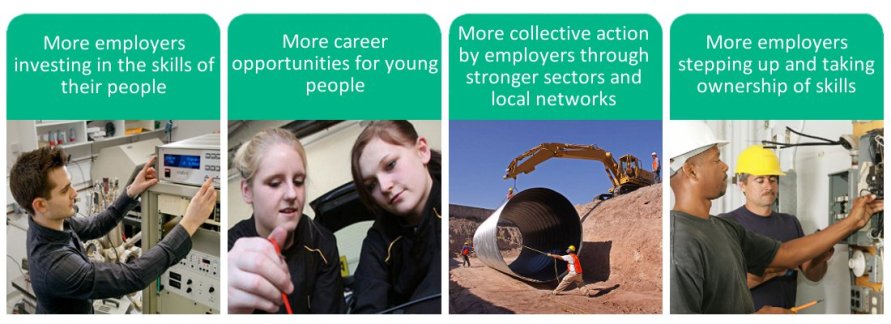
In pursuit of these objectives, our Commissioners are working towards achieving the following priority outcomes across the UK. Click the images to read more about our work on each outcome:
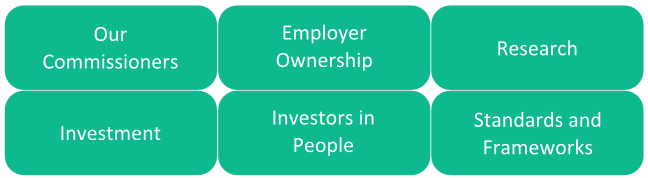
In order to deliver these outcomes, the UK Commission is delivering on and through the following key work areas. Click to read more about our work in each area:
Below, you can also browse our work by themes e.g. Apprenticeships, Information, Advice and Guidance etc. Use the A-Z if you know the name of the project you are looking for.
- Standards, qualifications and frameworks
- System reform
- work from previous years
work from previous years
Ambition 2020 (2009 and 2010)
12 Jun 2012
Ambition 2020: World Class Skills and Jobs was our assessment of progress towards the UK becoming world class in productivity, employment and skills by 2020.
Customer Journey
12 Jun 2012
This project investigated the individual’s experience of the employment and skills system on their journey into work, and progression in work and training.
Employee demand study
12 Jun 2012
For a core group of the UK’s employees, post-compulsory learning and skill development is not part of their life story. The Employee Demand project sought to understand why many employed people do not engage in learning and to explore the policy implications of this evidence.
Employer behaviour in relation to Investors in People
12 Jun 2012
The aim of this project is to further explore employer behaviour in relation to the Investors in People product and service offering.
Employer collective measures review
12 Jun 2012
The Employer Collective Measures project explored the levers of employer investment in skills and whether these are suboptimal. It also explored the effectiveness of levers available to encourage employers to invest collectively in skills.
Employer Voice
12 Jun 2012
The ’employer voice’ has an important role to play in shaping the employment and skills system by articulating what they need, advising how these needs can best be met and identifying market or system failures.
Empowering Customers: Labelling and Scorecards
12 Jun 2012
This work takes forward the proposal made in Towards Ambition 2020: Skills, jobs, growth to “Increase trust in, and authority to, learning providers, through the use of outcome-based public course labelling and institutional scorecards, which empower customers and communities to drive provider responsiveness, quality and continuous improvement”.
Encouraging employers to use human capital reporting: A review of options
13 Apr 2012
This Review explores options to encourage employers to adopt and use human capital reporting (HCR), in which employees are not solely seen as a cost but also as an intangible asset to their organisation. Greater HCR is seen as a way to optimise employer investment in workforce skills.
Impact of Higher Education on part-time students
12 Jun 2012
This project compares the labour market experiences of higher education graduates who studied on a full-time and part-time basis.
Information, advice and guidance
12 Jun 2012
This work explored how new technologies including web can be used to provide robust, accessible information, advice and guidance.
LMI think pieces
29 May 2012
The UK Commission commissioned a number of leading academic experts to undertake ‘think pieces’, setting out how, in their view, current sources of LMI in the UK might be improved.
National Occupational Standards (NOS) – Strategy
12 Jun 2012
The UK Commission for Employment and Skills worked with a wide range of stakeholders to develop and build consensus on the NOS Strategy. The four governments of the UK approved the NOS Strategy for 2010-20 at the end of March 2010 and agreed that the UK Commission should work with stakeholders in 2010/11 to prototype and pilot a number of aspects and evaluate these by the end of March 2011, to enable the full roll out of the Strategy from April 2011. This has resulted in Version 2 of the NOS Strategy and associated documents being published in June 2011
National Strategic Skills Audit
12 Jun 2012
The Audit provides detailed intelligence about the operation and structure of the labour market to inform the choices of individuals, employers and providers.
Occupational regulation and its impact
12 Jun 2012
This review deepens our understanding of one of a range of policy levers, or best market solutions, designed to encourage employers to train on a collective basis (Collective Measures).
Praxis
12 Jun 2012
Praxis is an occasional series of policy think pieces, which aims to challenge, inspire and stimulate discussion and debate.
Progression into Higher Education (HE)
12 Jun 2012
The UK Commission asked the Universities Vocational Awards Council (UVAC) to build on work they carried out for the Westminster government looking at progression routes to higher level skills provision in England for those with applied and vocational qualifications.
Review of Employment and Skills
12 Jun 2012
The UK Commission was commissioned by government in 2009 to assess the progress being made towards integrating the UK’s employment and skills systems and to make recommendations on what more needs to be done to integrate services further.
Skills utilisation
12 Jun 2012
This research project examined skills utilisation and its relationship with productivity, focusing specifically on the role of high performance working (HPW) in UK firms.
Stimulating Demand for Intermediate Skills amongst Employers
12 Jun 2012
This project aims to enhance understanding on the demand side, by in particular exploring the drivers of current demand for intermediate level skills amongst employers in England.
Tackling Exclusion
12 Jun 2012
This project was a scoping one, which aimed to identify employment and skills outcomes for the most excluded in society. And also assesses whether the current performance management and funding framework encourages providers to work with the hardest to help, and explored options of delivery that would improve outcomes for socially excluded groups.
Targets, measures, incentives and funding
12 Jun 2012
This project focused on identifying measures to support the success and raise the aspirations of delivery organisations in the UK.
Value of skills
12 Jun 2012
Making the business case for investing in skills starts with identifying the value of skills.
Women and work: Boosting women’s skills and career prospects
12 Jun 2012
The Women & Work Sector Pathways initiative finished 31 March 2011. From 1 April 2011 any Women and Work projects which continue will be funded through the Employer Investment Fund.
Youth Inquiry
12 Jun 2012
We were charged by Commissioners and key sponsors – DWP, the Welsh Government and the Scottish Government – to investigate the kind of activities, including improved education / employer engagement that most effectively support young people into employment, particularly those who are likely to be furthest from the labour market.
Back to top