Productivity Measures
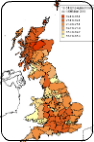
Indicators in this sector cover headline productivity measures by UK nation, region, and sector as well as comparing productivity levels internationally. GVA per job, per hour, and per worker are provided for sub-regional and sectoral estimates. International comparisons across the G7 and OECD are GDP per worker and per hour worked.
Productivity Driver: Investment
Investment per worker, gross fixed capital formation by sector, and business investment as a percentage of GDP across OECD countries are all indicators that can be found under this heading.
Productivity Driver: Leadership and Innovation
Innovation indicators included in this section include R&D expenditure within the UK and across OECD countries and data on subject of degree studied in Science, Technology, Engineering, and Mathematics (STEM) subjects.
A management quality indicator comparing key comparator countries is included in this section. The internal workings of the firm influence productivity (e.g. management and leadership, high performance working practices, and skills utilisation).
Productivity Driver: Enterprise and Competition
We present data on concentration of market share and the incidence of supernormal profits, as a monitor of competitive pressures – the greater the competition the lower these indicators will be.
Enterprise is the process of dynamic competition, for example the creation of new business opportunities within existing firms, or the setting up of new firms. Greater entrepreneurial activity can increase productivity. VAT-registrations are used here as a key measure of enterprise.
Productivity Driver: Skills
Skills indicators are presented in their own section of Almanac Online. Skills are a key driver of productivity, supporting raising productivity directly by increasing human capital, and indirectly through spillover effects. There are key inter-linkages between skills and the other drivers of productivity. For example competition puts pressure on firms to utilise resources in a more efficient manner; skills determine the effectiveness with which that is achieved. Higher skills encourage greater innovation; skills are critical to the development of new technologies and working practices. Enterprise is encouraged by higher level skills; managerial skills in particular are critical to the successful exploitation of new ideas.
Productivity Driver: Economic Cycle
The economic cycle plays a role in determining productivity. Indicators relating to the economic cycle can be found in the Context tab on Almanac Online. The ‘downward’ turning point of the economic cycle typically coincides with a marked slowdown of productivity growth, when output growth slows more rapidly than jobs are shed. To the extent that investment is cancelled or deferred, there is also an impact on long-term productivity growth. Against this, restructuring of the economy in recession may act to boost longer-term productive potential if the fittest and most efficient firms survive the tough times.