
Our workRSS Feed
Our mission is to work with and through our partners to secure a greater commitment to invest in the skills of people to drive, enterprise, jobs and growth.
Our strategic objectives in 2012/13 are:
- To provide world-class labour market intelligence which helps businesses and people make the best choices for them
- To work with sectors and business leaders to develop and deliver the best solutions to generate greater employer investment in skills
- To maximise the impact of changed employment and skills policies and employer behaviour to help drive jobs, growth and an internationally competitive skills base
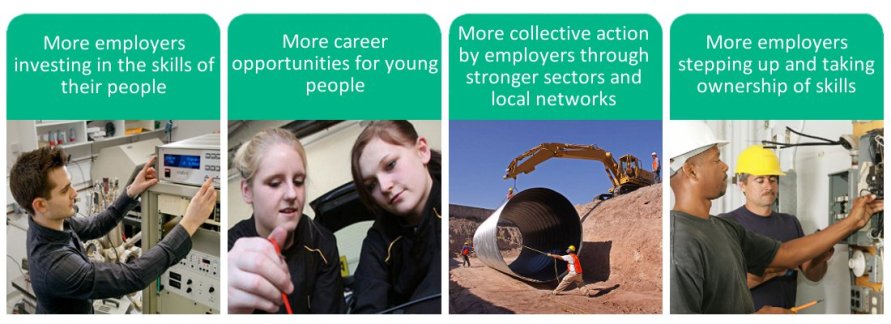
In pursuit of these objectives, our Commissioners are working towards achieving the following priority outcomes across the UK. Click the images to read more about our work on each outcome:
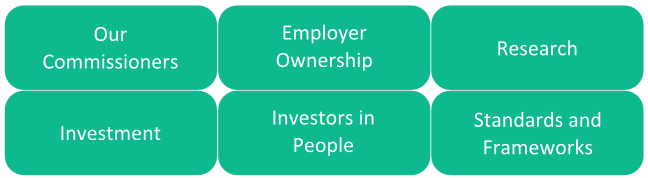
In order to deliver these outcomes, the UK Commission is delivering on and through the following key work areas. Click to read more about our work in each area:
Below, you can also browse our work by themes e.g. Apprenticeships, Information, Advice and Guidance etc. Use the A-Z if you know the name of the project you are looking for.
S
Sector Skills Councils
12 Jun 2012
Sector Skills Councils (SSCs) are independent, employer-led, UK–wide organisations. The SSCs and the UK Commission are committed to working in partnership across the four nations to create the conditions for increased employer investment in skills which will drive enterprise and create jobs and sustainable economic growth. They share a belief that the sectoral approach is the most effective way to do this.
Semta: Attracting new talent to fill in the skills gaps in SMEs through Apprenticeships
5 Jan 2012
This SEMTA project will contribute to achieving the vision of dramatically increasing the take up of apprenticeships and Modern Apprenticeships across the UK by supply chain companies.
Semta: Attracting new talent to fill in the skills gaps in SMEs through graduates
5 Jan 2012
This SEMTA project will contribute to achieving the vision of improving the quality and effectiveness of Small to Medium sized Enterprise (SME) engagement with Higher Education (HE).
Semta: Transforming the skills and productivity of the supply chain companies current workforce
5 Jan 2012
This SEMTA project will contribute to the vision of the science and engineering sector becoming world class by improving the productivity and competitiveness of 20,000 small and medium supply chain companies
Skills for Care and Development: ‘Learn from Learning’ – comparison website and toolkit
5 Jan 2012
This Skills for Care and Development project will develop an evaluation and benchmarking toolkit to help employers maximise their returns from spending on workforce and organisational development.
Skills for Care and Development: Mobile Learning and Knowledge Solutions
5 Jan 2012
This Skills for Care and Development project is to develop a range of learning resources and services designed for delivery on mobile devices. The intention is to provide freely available learning products for use across a range of devices including, Smartphones, ‘tablet computers’ and other readily available handheld consoles.
Skills for Care and Development: Recruiting a world class workforce
5 Jan 2012
This Skills for Care and Development project will develop innovative initiatives to increase the number of new recruits, improve perceptions of the care sector and stimulate growth.
Skills for Care and Development: Supporting employers with the workforce implications of Assistive Technologies
5 Jan 2012
This Skills for Care and Development project will take a strategic approach to the development of a national training strategy for assistive technology.
Skills For Health: Quality Mark
5 Jan 2012
Skills For Health will be developing a Quality Mark which will deliver a solution for employers to enable them to use available learning provision much more effectively.
Skills For Health: Role redesign for Support Workers
5 Jan 2012
This Skills For Health project will help workers in the health sector work more innovatively across traditional boundaries.
Skills For Health: Skills Utilisation (networks)
5 Jan 2012
This Skills For Health project will expand the use and take up of a number of pilots where productivity gains and quality improvements have been demonstrated through more effective use and deployment of workforce and skills.
Skills for Jobs, Strategic Skills Audit
Skills for Justice: High Performing People
10 Jan 2012
The unprecedented public sector reform requires new skills and a step change in individual performance. This Skills For Justice project will support a more modernised, flexible and diverse workforce which is needed to transform service delivery.
Skills for Justice: High Performing Workplaces
5 Jan 2012
Skills For Justice will trial and test the use and value of a range of existing tools including ISO and IiP across the sector and develop new tools in three test bed sites across the UK.
Skills for Justice: New Employers, new models
5 Jan 2012
Employers in the Justice sector have identified a need for support in using a range of business improvement and process re-engineering tools to deliver transformational change. Skills for Justice will trial and test the use and value of a range of existing tools including ISO and IiP across the sector and develop new tools in three test bed sites across the UK.
Skills For Justice: Working across boundaries
5 Jan 2012
The Justice sector has identified a need to realise cost savings by working together more effectively. Skills For Justice will work with employers in clusters, align job functions and define roles and responsibilities across organisations.
Skills for Logistics: Intelligent Logistics
11 Jan 2012
With ‘Intelligent Logistics’, Skills for Logistics will drive employer ownership of the skills system through the collation of intelligence derived from employer-led, occupational groupings.
Skills for Logistics: Local Logistics
11 Jan 2012
With ‘Local Logistics’, Skills for Logistics will create Local Logistics Community Networks (LLCNs) where clusters of employers will take action to activate local talent pools, attracting new and able job-seekers into the sector.
Skills for Logistics: Professional Logistics
11 Jan 2012
Through ‘Professional Logistics’, Skills for Logistics will drive employer ownership of the professionalisation and attractiveness of the sector by laying the foundations for the development of the UK Modern Logistics Guild (UKMLG).
Skills for Logistics: Progressive Logistics
11 Jan 2012
With ‘Progressive Logistics’, Skills for Logistics will increase access for employers to state-of-the-art, quality assured skills and training products in order to drive business and performance improvement, resulting in smarter investment in skills.
Skills pledge
12 Jun 2012
The development of a new pledge was set out in the skills strategy, Skills for Sustainable Growth. The Commission has developed proposals for an approach which fits firmly within our employer ambition strategy. We aim, in encouraging the development of pledges, to encourage increased investment in skills and to drive enterprise, create more and better jobs and support economic growth.
Skills utilisation
12 Jun 2012
This research project examined skills utilisation and its relationship with productivity, focusing specifically on the role of high performance working (HPW) in UK firms.
SkillsActive: Active Ambition
11 Jan 2012
In 2010, leading employers in leisure and fitness, through their trade associations, signed and committed to a Skills Protocol (Pledge), demonstrating their ambition and commitment to invest in skills. This investment builds on this and extends the approach across the SkillsActive sector. It will support the development of a ‘single qualifications framework’, ensuring that all employees have a training plan and support the development of a Chartered Institute for the sector.
Skillset: Creative Ambition
12 Jan 2012
Through ‘Creative Ambition’, Skillset will encourage collaboration and support collective action among employers and individuals to overcome the structural barriers to the acquisition of and investment in skills
Skillset: Creative Futures
12 Jan 2012
Creative Futures are strategic interventions and pilot schemes identified by employers and designed to achieve transformation in skills: the fusion of creative and STEM skills across the UK.
Skillset: Creative Intelligence (in collaboration with Creative & Cultural Skills)
12 Jan 2012
Through ‘Creative Intelligence’ Skillset (in collaboration with Creative and Cultural Skills) will deliver labour market information, research and evaluation enabling employers across the UK Creative Industries to better plan for, invest in, and measure the impact of skills and talent interventions.
Skillset: Creative Solutions
12 Jan 2012
Through ‘Creative Solutions’, Skillset will design, develop, test and launch a range of products and services specifically aimed at employers and individuals in the creative industries.
SME Gold Standard Skills
6 Oct 2011
Cogent are developing a bespoke approach for Small and Medium sized Enterprises (SMEs) which will increase employer investment in skills and raise professional standards through the use of the Gold Standard competency framework.
SSCs
Standards and Frameworks
12 Jun 2012
High value, high quality National Occupational Standards (NOS) and Apprenticeship Frameworks are critical tools which underpin employers’ ambition to raise skills levels and support individuals’ career aspirations.
Stimulating Demand for Intermediate Skills amongst Employers
12 Jun 2012
This project aims to enhance understanding on the demand side, by in particular exploring the drivers of current demand for intermediate level skills amongst employers in England.
Supporting the move to professional registration and voluntary Licence to Practise for the Automotive sector.
30 Jun 2011
This Institute of the Motor Industry (IMI) project is to build on the existing work of the Automotive Technician Accreditation scheme and develop a Professional Register which will reinforce the need for continuous professional development (CPD).
Back to top