
Our workRSS Feed
Our mission is to work with and through our partners to secure a greater commitment to invest in the skills of people to drive, enterprise, jobs and growth.
Our strategic objectives in 2012/13 are:
- To provide world-class labour market intelligence which helps businesses and people make the best choices for them
- To work with sectors and business leaders to develop and deliver the best solutions to generate greater employer investment in skills
- To maximise the impact of changed employment and skills policies and employer behaviour to help drive jobs, growth and an internationally competitive skills base
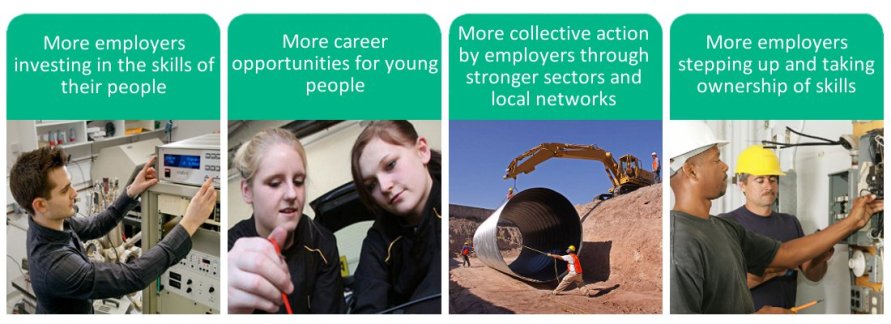
In pursuit of these objectives, our Commissioners are working towards achieving the following priority outcomes across the UK. Click the images to read more about our work on each outcome:
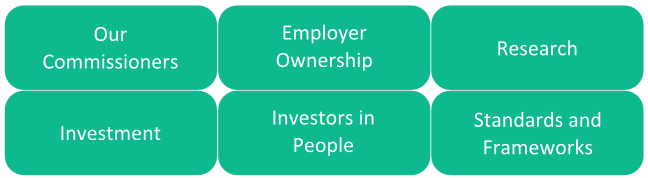
In order to deliver these outcomes, the UK Commission is delivering on and through the following key work areas. Click to read more about our work in each area:
Below, you can also browse our work by themes e.g. Apprenticeships, Information, Advice and Guidance etc. Use the A-Z if you know the name of the project you are looking for.
E
EIF phase one investments
30 Jun 2011
A table and range of documents which summarise all the EIF phase one investments.
EIF phase one investments
30 Jun 2011
A table and range of documents which summarise all the EIF phase one investments.
Employee demand study
12 Jun 2012
For a core group of the UK’s employees, post-compulsory learning and skill development is not part of their life story. The Employee Demand project sought to understand why many employed people do not engage in learning and to explore the policy implications of this evidence.
Employer behaviour in relation to Investors in People
12 Jun 2012
The aim of this project is to further explore employer behaviour in relation to the Investors in People product and service offering.
Employer collective measures review
12 Jun 2012
The Employer Collective Measures project explored the levers of employer investment in skills and whether these are suboptimal. It also explored the effectiveness of levers available to encourage employers to invest collectively in skills.
Employer Ownership of Skills – Pilot
Yesterday
The Employer Ownership pilot offers all employers in England direct access to up to £250 million of public investment over the next two years to design and deliver their own training solutions. The pilot is jointly overseen by UKCES, the Department for Business, Innovation and Skills and the Department for Education.
Employer surveys
12 Jun 2012
The UK Commission conducts two major employer surveys on a biennial basis, the UK Employer Skills Survey and the UK Employer Perspectives Survey. These surveys run in alternate years.
Employer Voice
12 Jun 2012
The ’employer voice’ has an important role to play in shaping the employment and skills system by articulating what they need, advising how these needs can best be met and identifying market or system failures.
Empowering Customers: Labelling and Scorecards
12 Jun 2012
This work takes forward the proposal made in Towards Ambition 2020: Skills, jobs, growth to “Increase trust in, and authority to, learning providers, through the use of outcome-based public course labelling and institutional scorecards, which empower customers and communities to drive provider responsiveness, quality and continuous improvement”.
Encouraging employers to use human capital reporting: A review of options
13 Apr 2012
This Review explores options to encourage employers to adopt and use human capital reporting (HCR), in which employees are not solely seen as a cost but also as an intangible asset to their organisation. Greater HCR is seen as a way to optimise employer investment in workforce skills.
Energy and Utility Skills: Generating Skills Investment through Supply Chain Collaboration
5 Jan 2012
Through this investment, Energy and Utility Skills will create a step change in the scale and efficiency in skills investment by the sector’s supply chain.
Energy and Utility Skills: Market Intelligence to raise Employer Investment
5 Jan 2012
Energy and Utility Skills will use this investment to deliver in-depth foresight work for the rapidly changing energy, utility and environmental sector. The investment will extend the use of the Energy and Utility Skills Workforce Planning Model (WPM), and will provide analysis of new skills needs on which investment decisions can be made.
Energy and Utility Skills: Raising the Sector Profile to Attract New Entrants
5 Jan 2012
Energy and Utility Skills will create a suite of interactive tools aimed specifically at potential new entrants to raise the profile of the sector. The interactive tools will be supplemented by new e-learning materials for careers advisors and influencers. A Green Ambassadors programme will be rolled out across the four nations to work with schools to stimulate interest in careers in the Renewables sector.
Energy and Utility Skills: Stimulating New Entrant Training in Renewable Energy
5 Jan 2012
This Energy and Utility Skills project will deliver extensive and co-ordinated engagement and actions including the creation of a Group Skills Purchasing Scheme. The investment will also provide quality assured training to address the skills needed for the delivery of new energy technologies and to meet the anticipated growth in jobs in renewable energy.
Engaging low skilled employees in workplace learning
12 Jun 2012
The Employee Demand study (2009) highlighted the significant barriers to learning that are faced by a number of UK employees. The engaging low skilled employees study aims to identify the importance of different barriers and identify approaches to influence behaviour. The study implements a stated preference technique.
e-skills UK: Cyber Security Learning Pathways
5 Jan 2012
e-skills UK is developing Cyber Security Pathways; sector-backed learning pathways for cyber security. The aim is to drive the uptake of vital skills and qualifications in the IT sector.
e-skills UK: Employment and Entrepreneurship
5 Jan 2012
This e-skills UK project will help businesses and individuals develop the skills to participate fully in the e-economy. This will be achieved through increasing digital literacy among employers and working with “Startup Britain” to help entrepreneurs to make the most of technology to promote innovation and growth.
e-skills UK: Higher Education Pathways
5 Jan 2012
Through this investment e-skills UK will develop a world-class pipeline of graduate talent into IT careers. Employers will support the enhancement of university degrees and offer attractive student placements, this will also address gender imbalance in IT degrees.
e-skills UK: Informed Choices
5 Jan 2012
e-skills UK will use this investment to inspire young people to pursue IT-related education and careers in the high growth IT sector
e-skills UK: Sector Managed Apprenticeships
5 Jan 2012
e-skills UK is creating a sector-managed Apprenticeship programme to increase Apprenticeship engagement in the IT sector for individuals and Small and Medium Enterprises (SMEs). This model will be delivered through employers and will give organisations access to a Talent Pool of quality Apprentices.
e-skills UK: Vocational Pathways
5 Jan 2012
Through this investment, e-skills UK will transform the opportunity for people to enter IT through vocational pathways rather than the traditional academic route.
e-skills UK: Workforce Skills
5 Jan 2012
This e-skills UK project will enable the UK’s IT professional workforce to better derive business value from technology through the adoption of IT Professional Standards, and skills benchmarking using a common language.
Extending the Tick – a skills sat-nav
30 Jun 2011
Skillset is creating a gold standard for the creative industries signposting the very best in training and education, the Skillset Tick. This project will extend the kitemark to Apprenticeships, Internships, vocational progression and feeder courses. It will also provide a navigation tool to identify good practice.
Back to top